





 | ISBN: 978-1-58826-646-0 $65.00 | |
| ISBN: 978-1-58826-623-1 $28.50 | ||
| ISBN: 978-1-62637-060-9 $28.50 | ||
| 2009/310 pages/LC: 2009002520 | ||
Winner of the 2010 African Politics Conference Group Best Book Award!
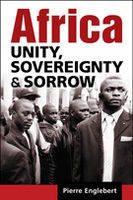
Though the demise of one or another African state has been heralded for nearly five decades, the map of the continent remains virtually unchanged. By and large, these states have failed to protect and promote the interests of their citizens; yet they endure.
Asking why, Pierre Englebert carefully articulates the manner in which international sovereignty is translated into domestic legal command—and the sorrow that ensues.
"Beautifully written, [this] book provides the reader with a theory-driven analysis of Africa's contemporary politics at its best."—William Reno, Perspectives on Politics
"Several audiences will owe Englebert an intellectual debt for disentangling the obtuse relationships between domestic legitimacy and external sovereignty, and for adumbrating the ignored possibilities."—A. Carl LeVan, Political Science Quarterly
"Africa: Unity, Sovereignty, and Sorrow is, in the best sense of the term, a provocation.... [A] rare combination of rigorous scholarship, compelling narrative, and innovative prescriptions."—J. Peter Pham, Journal of the Middle East and Africa
"Powerful.... Provides an explanation both of why weak or failed states endure and why potential challengers to the holders of state power have vested interest in avoiding structural change.... The other great strength of this book is that it is both systematic and very richly documented.... This is an impressive and compelling book."—Patrick Chabal, International Affairs
"A perceptive analysis that organizes the variety of consequences of the end of colonialism."—Choice
"Brimming with arguments, ideas, and penetrating analyses.... Englebert offers new angles on old controversies, all reflecting erudite scholarship, deep historical knowledge, and rigorous methodology.... Refreshingly contrarian yet totally commonsensical, his book is meant to become an instant classic."—Célestin Monga, Massachusetts Institute of Technology and World Bank
"One might quibble about the paradoxes of Africa and its institutions, and about the objective indicators of state crisis, but one cannot deny the provocative seriousness with which this richly documented book poses the question of agency in Africa."—Francis B. Nyamnjoh, CODESRIA
"Powerful and compelling.... This is the rare book that offers surprising new insights into fundamental questions about statehood, sovereignty, and political survival. It is an analysis that should be widely read."—Michael L. Ross, University of California, Los Angeles
"A systematic and insightful study of the paradox of resilient state authority in an Africa of weak and failed states. Englebert has created the template for future examinations of this central dilemma."—Richard Joseph, Northwestern University
"Splendid ... richly documented and sparkling with insights. This is a seminal contribution to our understanding of the African state."—M. Crawford Young, University of Wisconsin–Madison