Authoritarianism in the Middle East: Regimes and Resistance
Marsha Pripstein Posusney and Michele Penner Angrist, editors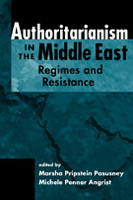 | | ISBN: 978-1-58826-342-1 $25.00 |
| 2005/276 pages/LC: 2005011302 |
DESCRIPTION
Why do authoritarian regimes prevail in the Middle East, while successful democratic transitions are occurring elsewhere in the developing world? Authoritarianism in the Middle East addresses this question, focusing on the role of political institutions and the strategic choices made by both rulers and opposition challengers. The authors eschew cultural explanations, highlighting instead the importance of robust coercive apparatuses in the region and the context of incumbent-opposition struggles. Their work sheds light on pivotal political dynamics throughout the Middle East, revealing the numerous ways in which the balance of power continues to favor the status quo.
ABOUT THE AUTHOR
The late Marsha Pripstein Posusney was professor of political science at Bryant University and adjunct professor of international relations at the Watson Institute for International Studies, Brown University. Her publications included Labor and the State in Egypt, winner of the Hourani prize, and Women and Globalization in the Arab Middle East (coedited with Eleanor Doumato). Michele Penner Angrist is assistant professor of political science at Union College. She is the author of Party Building in the Modern Middle East.
CONTENTS
- Introduction: The Middle East's Democracy Deficit in Comparative Perspective—M.P. Posusney.
- THE REINS OF POWER.
- Coercive Institutions and Coercive Leaders—E. Bellin.
- Political Crisis and Restabilization: Iraq, Libya, Syria, and Tunisia—J. Brownlee.
- Contestation Without Democracy: Elite Fragmentation in Iran—A. Keshavarzian.
- CHALLENGES TO AUTHORITARIAN RULE.
- Multiparty Elections in the Arab World: Election Rules and Opposition Responses—M.P. Posusney.
- Party Systems and Regime Formation: Turkish Exceptionalism in Comparative Perspective—M.P. Angrist.
- Opposition and Economic Crises in Jordan and Morocco—E. Lust-Okar.
- Princes, Parliaments, and the Prospects for Democracy in the Gulf—M. Herb.
- Too Much Civil Society, Too Little Politics? Egypt and Other Liberalizing Arab Regimes—V. Langohr.
- CONCLUSION.
- The Outlook for Authoritarians—M.P. Angrist.






"A good primer to an understanding of the dynamics of enduring authoritarianism in the Arab world, and the possible pathways to its democratic replacement."—John P. Entelis, Journal of North African Studies
"Provides some of the best analysis one can find anywhere of Middle Eastern politics and particularly of the reasons for the persistence of authoritarianism in that region."—Glenn E. Perry, Digest of Middle East Studies
"An excellent volume ... there is nothing else like it. Here, at last, is a book that looks at the politics of change and stability in the Middle East."—Lisa Anderson, Columbia University
"The quality of analysis found here is well ahead of the popular discussion about whether democracy and Islam are compatible."—William B. Quandt, University of Virginia
"It is good to see big questions like 'Why has democracy failed in the Middle East?' answered with both sophistication and clarity."—Russell E. Lucas, University of Oklahoma