
Sort by: Author | Title | Publication Year
BOOKS
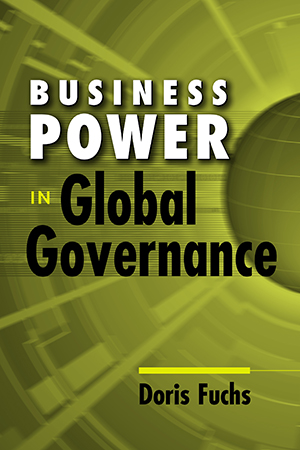
Business Power in Global GovernanceDoris Fuchs Has the political power of big business, particularly transnational corporations (TNCs), increased in our globalizing world? What, if anything, constrains TNCs? Analyzing the role of business in the global arena, this systematic and theoretically grounded book addresses these questions. Fuchs considers the implications of expanded lobbying efforts by businesses and business associations, the More > | ![]() |
Constituting International Political EconomyKurt Burch and Robert A. Denemark, editors International political economy is both a discipline and a set of global practices and conditions. This volume explores how the two are related, illustrating the changing character of the global political economy, as well as changing perspectives on that character. The authors first consider how social issues, policy concerns, and philosophical judgments help constitute IPE both as a worldview More > |
Crime and the Global Political EconomyH. Richard Friman, editor Crime has gone global. Conventional explanations point to ways in which criminals have exploited technological innovations, deregulation, and free markets to triumph over state sovereignty. Crime and the Global Political Economy reveals a more complex reality. Taking as a point of departure the reality that state and societal actors are challenged by—and complicit in—the More > | ![]() |
Development and Underdevelopment: The Political Economy of Global Inequality, 4th editionMitchell A. Seligson and John T Passé-Smith, editors This new edition of Development and Underdevelopment retains the strongest contributions of the previous three editions, but includes 12 new chapters that reflect the many seminal contributions made to the field in recent years. There are also two new sections: one addressing the historical origins of the gap between rich and poor countries, and one focusing on how globalization has More > | ![]() |
Drug Trafficking in the AmericasBruce M. Bagley and William O. Walker III, editors The authors analyze the political economy of drug trafficking in Latin America and the Caribbean and its effects on U.S.-Latin American relations. Special attention is given to both U.S. drug policy with respect to the region and multilateral efforts at drug control. Case studies include Colombia, Peru, Bolivia, Ecuador, Mexico, Paraguay, Central America, and the Caribbean. More > |
European Monetary Integration and Domestic Politics: Britain, France, and ItalyJames I. Walsh This book explains why three countries—Britain, France, and Italy—that have faced similar problems of high inflation and currency depreciation since the 1970s—Britain, France, and Italy—have pursued very different international monetary strategies. Walsh argues that international monetary policies produce predictable sets of winners and losers, and that policy choice is a More > |
Forced Labor: Coercion and Exploitation in the Private EconomyBeate Andrees and Patrick Belser, editors Two centuries after the abolition of the transatlantic slave trade, at least 12.3 million people are subjected to modern forms of forced labor—in rich countries, as well as poor ones. The authors of Forced Labor present state-of-the art research on the manifestations of these slavery-like practices, why they continue to survive, and how they can be eliminated. Their conceptually More > | ![]() |
Foreign Investment and Domestic Development: Multinationals and the StateJenny Rebecca Kehl How is it that, in a time of unprecedented global opulence and market activity, billions of dollars flow through the developing world without altering its reality of poverty and scarcity? Jenny Kehl explores the crucial relationship between foreign direct investment and domestic development, focusing on the wide variation in the capacity of governments to negotiate FDI to the advantage of their More > | ![]() |
Getting Globalization Right: The Dilemmas of InequalityJoseph S. Tulchin and Gary Bland, editors Getting Globalization Right explores political and economic changes in seven new democracies that have in common both a movement toward greater integration with the world economy and the challenges posed by persistent or even increasing domestic economic inequalities. The authors argue that, without effective national policies to dampen the effects of globalization, the More > | ![]() |
Global Corporate PowerChristopher May, editor Exploring the diverse ways that corporations affect the practices and structures of the global political economy, this innovative work addresses three fundamental questions: How can the corporation be most usefully conceptualized within the field of IPE? Does global governance succeed in constraining the power of multinational corporations? To what extent has the movement for corporate social More > | ![]() |
Globalization and Change in AsiaDennis A. Rondinelli and John M. Heffron, editors Globalization and Change in Asia explores three decades of adjustment on the part of governments, civil society, and the private sector to the complex new forces of international competition. Recognizing that the benefits of globalization have not accrued equally to all Asian countries, nor to all stratums of society, the authors seek lessons that can help shape development policy to More > | ![]() |
Globalization and Inequality: Neoliberalism's Downward SpiralJohn Rapley Has the far-reaching experiment in creating a new world order along neoliberal lines succeeded? John Rapley answers with an emphatic no, contending that the rosy picture painted by neoliberal proponents of globalization was based on false assumptions. True, Rapley acknowledges, neoliberal reforms often did generate economic growth—but at a price. The resulting increase in inequality More > | ![]() |
Globalization in Africa: Recolonization or Renaissance?Pádraig Carmody Is globalization good for Africa? Pádraig Carmody explores the evolving nature and impact of globalization throughout the continent, as China, the US, and other economic powers exert their influence. Drawing especially on the cases of Chad, Sudan, and Zambia, Carmody considers whether the resource curse that has for so long plagued Africa can become a blessing. He also evaluates the More > | ![]() |
Globalization: Critical ReflectionsJames H. Mittelman, editor This book analyzes the empirical trends constituting the globalization process in the late twentieth century and explains its underlying causes and consequences. The authors explore the globalization of production, challenges to the state system represented by the contradictory pressures of sub- and supranationalism, and linkages between regionalism and globalizing tendencies. They also consider More > |
Gods, Guns, and Globalization: Religious Radicalism and International Political EconomyMary Ann Tétreault and Robert A. Denemark, editors Is it accurate to equate "fundamentalism" with antimodernism? What explains the growing importance of religious activists in world politics? Guns, Gods, and Globalization explores the multifaceted phenomenon of religious resurgence, ranging from the Christian right in the U.S. to ethnonationalist movements across North Africa and Asia. The authors' focus on the complex More > | ![]() |
Guns and Butter: The Political Economy of International SecurityPeter Dombrowski, editor Reflecting the growing interest among scholars and practitioners in the relationship between security affairs and economics, this new volume explores the nature of that relationship in the first decade of the 21st century. Among the issues addressed in the book are the impact of the events of September 11 and of the US response. The authors also consider whether the challenges of the More > | ![]() |
Human Rights in the Global Political Economy: Critical ProcessesTony Evans Tony Evans critically investigates the theory and practice of human rights in the current global order. Evans covers a range of contentious debates as he considers critiques of the prevailing conceptions of human rights. He then explores the changing global context of human rights issues, the nature and status of human rights within that context, and recent institutional responses. With its More > | ![]() |
Intellectual Property Rights: A Critical HistoryChristopher May and Susan K. Sell With intellectual property widely acknowledged today as a key component of economic development, those accused of stealing knowledge and information are also charged with undermining industrial innovation, artistic creativity, and the availability of information itself. How valid are these claims? Has the Trade Related Aspects of Intellectual Property Rights (TRIPs) Agreement ushered in a new, More > | ![]() |
International Political Economy: State-Market Relations in a Changing Global Order, 2nd EditionC. Roe Goddard, Patrick Cronin, and Kishore C. Dash, editors Introducing the classic and contemporary ideologies of international political economy—and especially the ways that affect the behavior of states and markets—this anthology has been carefully constructed for classroom use. Articles representing contending views of IPE are followed by selections on the international monetary system, development assistance, and international More > | ![]() |
Knowledge Power: Intellectual Property, Information, and PrivacyRenée Marlin-Bennett Knowledge Power introduces the interconnected roles of intellectual property, information, and privacy and explores the evolution of the domestic and international rules that govern them. What roles are played by governments, individuals, firms, and others in shaping our knowledge world? How will the rules that we create—or unquestioningly accept—affect the contours More > | ![]() |
Negotiating Privacy: The European Union, the United States, and Personal Data ProtectionDorothee Heisenberg How did the European Union come to be the global leader in setting data privacy standards? And what is the significance of this development? Dorothee Heisenberg traces the origins of the stringent EU privacy laws, the responses of the United States and other governments, and the reactions and concerns of a range of interest groups. Analyzing the negotiation of the original 1995 EU Data More > | ![]() |
Profiting from Peace: Managing the Resource Dimensions of Civil WarKaren Ballentine and Heiko Nitzschke, editors Providing both a means and a motive for armed conflict, the continued access of combatants in contemporary civil wars to lucrative natural resources has often served to counter the incentives for peace. Profiting from Peace offers the first comprehensive assessment of the practical strategies and tools that might be used effectively, by both international and state actors, to help reduce More > | ![]() |
Property and the Making of the International SystemKurt Burch This original work considers the emergence of the modern international system—that is, the global social context framing the diverse behaviors called international relations—in terms of the concepts of property and property rights. Burch argues that the development of "property" is a crucial aspect of contemporary claims about the modern state, sovereignty, international More > |
Racing to Regionalize: Democracy, Capitalism, and Regional Political EconomyKenneth P. Thomas and Mary Ann Tétreault, editors The intensifying proliferation of regional organizations over the last decade is explored in this volume, which focuses on the workings of APEC, the European Union, the Gulf Co-operation Council, Mercosur, and NAFTA. The authors examine a number of critical issues: How does politics shape the construction of regional agreements? To what extent do these agreements incorporate or limit economic More > |
The Global Economy as Political SpaceStephen J. Rosow, Naeem Inayatullah, and Mark Rupert, editors As contemporary capitalism integrates the planet to an unprecedented extent, the international political economy defines and constitutes new forces, practices, and movements. Not only are power centers shifting away from Cold War poles, but also the spatial and temporal frames of social life, both domestic and international, are reorganizing. Addressing these transformations, the authors of this More > |
The International Political Economy of the Environment: Critical PerspectivesDimitris Stevis and Valerie J. Assetto, editors When considering the nature of environmental problems, many scholars and practitioners assume that—while there may be disagreement about solutions—we know what the problems are. In contrast, the authors of this volume investigate the framing of both problems and solutions to clarify the particular political dynamics and preferences that they reflect and legitimate. They test their More > | ![]() |
The Political Economy of Armed Conflict: Beyond Greed and GrievanceKaren Ballentine and Jake Sherman, editors Globalization, suggest the authors of this collection, is creating new opportunities—some legal, some illicit—for armed factions to pursue their agendas in civil war. Within this context, they analyze the key dynamics of war economies and the challenges posed for conflict resolution and sustainable peace. Thematic chapters consider key issues in the political economy of More > | ![]() |
The Political Economy of Sanctions Against ApartheidHaider Ali Khan Existing political economy analyses of the arguments for and against imposing economic sanctions against South Africa, however astute, suffer from a lack of empirical analysis at any but the most descriptive level. Professor Khan has developed a new approach to the topic of the sanctions, combining the imperatives of capital accumulation and growth in South Africa with the particular political and More > |
The Reform of the Bolivian State: Domestic Politics in the Context of GlobalizationAndreas Tsolakis In 2005, two decades after President Victor Paz Estenssoro's New Economic Policy heralded the beginning of a profound transformation for Bolivia, violence had become endemic in the country, economic growth was weak, and political corruption was flourishing. Evo Morales was elected to the presidency in a climate of intense social conflict and disorder, promising to deconstruct the entire political More > | ![]() |
The World Trade Organization: Changing Dynamics in the Global Political EconomyAnna Lanoszka A comprehensive examination of the World Trade Organization, this new book covers all the basics: the WTO’s history, its structure, and its practices and concerns. Beginning with an overview of the world trading system since the end of World War II, Lanoszka explains the profound changes brought about by the establishment of the WTO. Then, a discussion of the organization’s structure, More > | ![]() |
Tourists, Migrants, and Refugees: Population Movements in Third World DevelopmentMilica Z. Bookman As travelers increasingly seek out the exotic wildlife and idyllic sunsets of the developing world, a complex relationship involving tourism, the migration of workers, and the involuntary displacement of peoples has emerged. Milica Bookman explores that relationship—and the connection between population movements and economic development in third world countries. Bookman's multicountry More > | ![]() |
U.S. Politics and the Global Economy: Corporate Power, Conservative ShiftRonald W. Cox and Daniel Skidmore-Hess This thoughtful, highly original book investigates the influence of globalization on ideology and politics in the United States. Cox and Skidmore-Hess argue that U.S. policy increasingly has been motivated less by anxiety about the independence and stability of the domestic economy and more by worry about factors that might limit the participation of U.S. corporations in international markets. More > |
War Economies in a Regional Context: Challenges of TransformationMichael Pugh and Neil Cooper, with Jonathan Goodhand Confronting the corrosive influence that war economies typically have on the prospects for peace in war-torn societies, this study critically analyzes current policy responses and offers a thought-provoking foundation for the development of more effective peacebuilding strategies. The authors focus on the role played by trade in precipitating and fueling conflict, with particular emphasis More > | ![]() |
Workers Without Frontiers: The Impact of Globalization on International MigrationPeter Stalker This unique assessment of a complex and contentious issue brings together the latest information on international migration in the context of a global economy. Redressing a gap in most discussions of globalization, Stalker examines how migration interacts with movements of goods and capital, and how it is closely tied to social and economic changes. He makes starkly clear the major impact that More > |