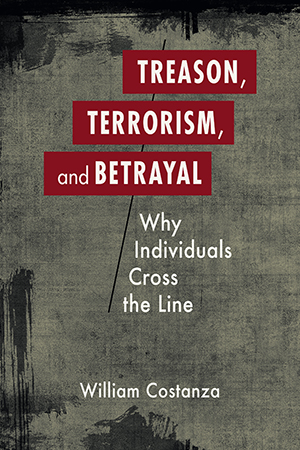
Aldrich Ames. Timothy McVeigh. Kim Philby. Julius and Ethel Rosenberg. Edward Snowden. These are just a few of the people well known for willfully jeopardizing US national security. What compelled them and others like them to commit such acts? Can the danger be detected before it’s too late?
William Costanza employs an interdisciplinary approach to reveal the many intertwined factors that might lead a person down a path to espionage, terrorism, or betrayal. Drawing on a wide range of detailed case studies, he proposes tools for better understanding why some individuals "cross the line" and, as a result, for better deterring threats.
William Costanza, a scholar in the field of intelligence and security studies, served as a senior operations officer with the CIA for more than two decades.
Also of interest: Ethical Espionage: Ethics and the Intelligence Cycle by Jan Goldman "A compelling and intellectually rigorous contribution to the study of espionage, insider threats, and the psychology of those who 'cross the line.'" —Roberto Lafforgue
"[Costanza] challenges readers to think beyond stereotypes of traitors as simple villains and instead consider the complex interplay of personal motive, institutional pressure, and geopolitical context.... A worthy contribution." —Sean Wiswesser, The Cipher Brief
"Highly recommended." —Choice
"Ambitious, well-sourced, and eminently useful.... A unique and important contribution to the study of an enduring problem." —Joseph Gartin, Intelligence Officer's Bookshelf
"A must read for those interested in insider threats and their impact on U.S. National Security." —Keith Cozine, St. John's University
"In his thoughtful book, Costanza looks across disciplines and methodologies for insights into why an individual might decide to 'cross the line'—and the limits on our understanding of such complex human behavior…. A valuable resource, not only for the case studies and analysis it provides, but also for the key challenges it lays out for the future." —Michelle Van Cleave, former head of US counterintelligence
"Rejecting the idea that the actions of individuals who have harmed or threatened the security of the United States can be explained simply, Costanza argues convincingly that a complex interplay of personal and professional issues motivated those individuals to 'cross the line.'"—Gregory Moore, Notre Dame College
"A fascinating read…. The detailed descriptions of each of the 'betrayers' are not just informative, but revelatory of the different variety of motivations that drive each individual to treason and terror.” —Stephen Kappes, former head of counterintelligence and deputy director of the Central Intelligence Agency